


Following the successful completion of Operation "Maestral," the Croatian military and political leadership, with the open support of the American administration, decided to continue offensive actions against Republika Srpska. The goal was to force a crossing of the Una and Sava rivers, capture strategically important towns—Novi Grad, Kostajnica, and Kozarska Dubica—and create a direct threat to Prijedor and Banja Luka.
American Pressure and Political Background
Immediately before the start of the operation, American diplomat Richard Holbrooke visited Zagreb. According to his later writings, he actively encouraged Franjo Tuđman to continue military actions. In his book "To End a War," Holbrooke wrote:
"I urged Tuđman to take Sanski Most, Prijedor, and Bosanski Novi, all important towns that had become world-famous symbols of ethnic cleansing. If they captured them before we opened negotiations on territory, they would remain under Federation control. Otherwise, it would be very difficult to obtain them during negotiations."
NATO Bombing and Preparations for Operation "Una 95"
The Croatian side entered the offensive, code-named Operation "Una 95," based on incorrect intelligence assessments. It was believed that the aforementioned towns were almost abandoned and that the main forces of the Army of Republika Srpska (VRS) had withdrawn toward Prijedor. Simultaneously with the preparations for the attack, NATO was bombing VRS positions. The Army of Republika Srpska suffered a particularly heavy blow on September 13, 1995, when NATO aviation destroyed the main telecommunications transmitter on Kozara, leaving the VRS in this part of Republika Srpska largely without radio communication and forced to rely on courier communication.
Composition and Directions of Attack by Croatian and Muslim Forces
To carry out Operation "Una 95", the Croatian Army mobilized significant forces. According to the actual situation on the ground, it had a total of 12 maneuver units available for the attack. Out of these, two were guards brigades—the 1st Guards Brigade "Tigers" and the 2nd Guards Brigade "Thunders"—while the remaining ten consisted of Home Guard regiments, namely: the 1st, 2nd, 4th, 12th, 17th, 20th, 52nd, 57th, 121st, and 125th Home Guard regiments or brigades. Along with these forces, two mixed armored-mechanized combat groups were deployed, each at the strength of a reinforced company, formed from the armored battalions of the 1st and 2nd Guards Brigades, armed with M-84 and T-55 tanks, as well as M-80A infantry fighting vehicles.
The 5th Corps of the so-called Army of the Republic of Bosnia and Herzegovina was supposed to coordinate with the Croatian forces, committing the 505th, 511th, and 517th Mountain Brigades to the attack. The main directions of their operation were Bosanska Krupa – Sanski Most – Prijedor and Sanski Most – Bronzani Majdan – Banja Luka, with the aim of penetrating deep into the territory of Republika Srpska and creating operational pressure on Prijedor and Banja Luka.
Defensive Preparations of the Army of Republika Srpska
On the other hand, after the fall of the Republic of Serbian Krajina, the Main Staff of the Army of Republika Srpska formed Operational Group 10 based in Prijedor. It was composed of the 1st Novi Grad Infantry Brigade, the 1st Prnjavor Light Infantry Brigade, the "Balj" Combat Group, the 11th Dubica Brigade, and the 1st Gradiška Light Infantry Brigade. Their task was to defend the line of the Una and Sava rivers, from Novi Grad to Gradiška.

Start of the Operation and First Attempts to Force the Una
On September 18, 1995, in the early morning hours, following a powerful and evenly distributed artillery preparation, members of the 1st and 2nd Guards Brigades began forcing a crossing of the Una River. Initial success was partial: small bridgeheads were formed in the areas of Kozarska Dubica and Novi Grad, while the "Balj" Combat Group in Kostajnica prevented a sabotage crossing attempt over a damaged bridge.
After the initial surprise, units of the Army of Republika Srpska quickly consolidated, and fierce battles for the bridgeheads followed. Croatian artillery continued indiscriminate shelling of residential areas, causing great destruction and numerous civilian casualties. By the late evening hours of September 18, and especially during September 19, the VRS managed to completely block all bridgeheads and push the Croatian forces back to the left bank of the river.
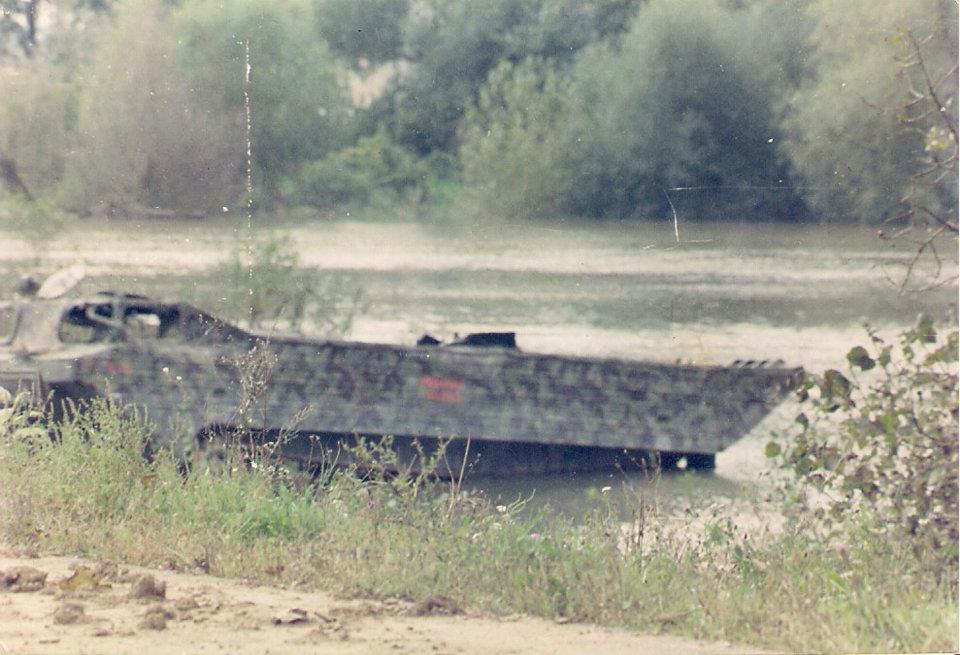
On September 19, in the area of Donja Gradina—the territory of the former largest execution site of the Jasenovac Concentration Camp, a symbol of the Genocide against Serbs in the Independent State of Croatia (NDH)—Croatian forces attempted another forced crossing of the Sava River. However, the 11th Dubica Brigade reacted in a timely manner, defended against multiple attacks, and destroyed a Croatian amphibious vehicle, completely thwarting this river crossing attempt as well.
Completion of the Operation and Withdrawal of the Attackers
In the morning hours of September 20, 1995, commanders on the ground reported that there were no longer any members of the Croatian forces on the right banks of the Una and Sava. Units of the Army of Republika Srpska reoccupied all previous zones of responsibility and defense sectors, formally ending Operation "Una 95" as a failure for the Croatian forces.
Civilian Casualties and Destruction
In the span of just three days, despite the significant material superiority of the attacker, poor communications, and strong external pressure, Operational Group 10 of the Army of Republika Srpska managed to defend the river line and prevent a breakthrough toward strategically important towns in the northwestern part of Republika Srpska.
Operation "Una 95" left severe and tragic consequences, especially for the civilian population of the affected areas. Indiscriminate artillery shelling of populated areas and fighting in the immediate vicinity of civilian zones led to significant human losses and great material destruction in Novi Grad, Kozarska Dubica, and Kostajnica. According to available data, a total of 104 people died on the Serbian side: 54 soldiers and police officers and 50 civilians, including a large number of women, elderly people, and children.
Strategic Importance of the Defense
During Operation "Una 95," Croatian forces suffered significant losses. According to Tomislav Kovačić's monograph, "Operation 'Una' – A Game of Cards and the Fog of War on the Una and Sava in September 1995," the Croatian Army had 50 members killed or missing, as well as between 155 and 197 wounded.
The defense of the river line was of exceptional military-strategic importance for Republika Srpska, as it thwarted the further advancement of Croatian forces and prevented a breakthrough toward Prijedor and Banja Luka, halting the direct threat to the northwestern part of Republika Srpska. Operation "Una 95" also represented the first clearly manifested major military failure of the Croatian Army in 1995. The wider political-military echo of this failure was reflected not only in the realization that further offensive attempts carried a high price and an uncertain outcome but also in the fact that this victory by the Army of Republika Srpska showed that, despite the joint offensive of Croatian forces, the so-called Army of BiH, and NATO airstrikes, the VRS was not defeated; instead, it retained its combat capability, operational organization, clear will for defense, and the ability to carry out successful combat operations.
Recommended Literature:
-
- Марко Јанковић, „Дубички 20. вијека“, Бања Лука 2018, 146–155.
- Милоја М. Мисирача, „Козарска Дубица у Отаџбинском рату 1991-1995“, Козарска Дубица-Бања Лука 2018, 463-521.