
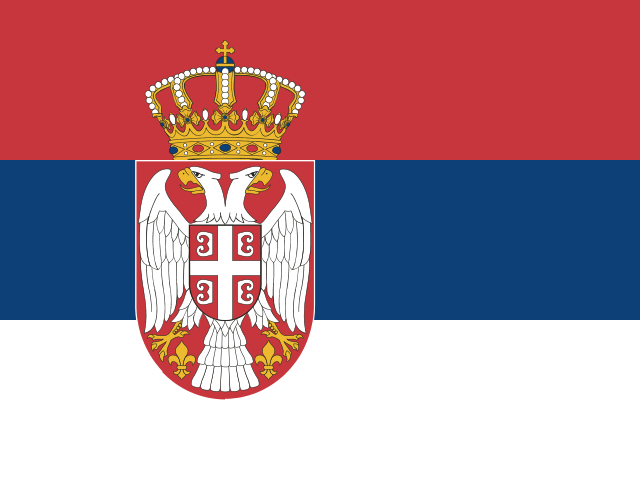


The first multi-party elections in the Socialist Republic of BiH were held on November 18, 1990. Voters cast their ballots for members of the Presidency of the republic, representatives in both Chambers of the assembly, councilors for 109 municipal assemblies, and the Assembly of the City of Sarajevo.
The newly founded national parties won a sweeping victory, securing 84% of the mandates in the Assembly. The SDA won 86 seats, the SDS 72, and the HDZ 44, while the remaining seven parliamentary parties held 34 seats.
Disagreements among the ruling coalition emerged as early as the first sessions of the Assembly. The question of the political dissolution of the SFRY was raised increasingly seriously, and the parties held diametrically opposed views on the matter.
Over time, the SDA and HDZ increasingly clearly and publicly advocated for the adoption of a declaration on the sovereignty and indivisibility of Bosnia and Herzegovina.
Alija Izetbegović threatened that he would "sacrifice peace for a sovereign Bosnia," while Radovan Karadžić believed that preserving the sovereignty of Yugoslavia was the primary goal for the Serbian people.
Political Crisis and the Foreshadowing of Civil War
After a year-long political crisis, the turning-point sessions of the BiH parliament were held in October 1991, clearly foreshadowing the possibility of civil war. The trigger for the conflict was the SDA's Memorandum on the Sovereignty of Bosnia and Herzegovina.
At an illegally continued session of the Assembly of Bosnia and Herzegovina, without the presence of 72 SDS representatives and one SPO representative, chaired by Vice-President Mariofil Ljubić, the Platform of the Presidency of BiH, the SDA's Memorandum on the Sovereignty of BiH, and the Letter of Intent were adopted, and a Referendum on the Sovereignty of BiH was called.
Also, at this assembly session, it was decided that conscripts and reservists would no longer be sent to the JNA, and the mobilization of the reserve forces of the Ministry of the Interior (MUP) was carried out.
In response to the practically unilateral declaration of BiH's secession by the SDA and HDZ, the SDS issued a proclamation to the Serbian people, the citizens of BiH, and Yugoslavia regarding the final session of the BiH Assembly, where on the night between October 14 and 15, 1991, the SDA and HDZ passed the Memorandum on the Sovereignty of BiH, thereby attempting to execute a coup d'état.
The Founding of Institutions and the Republic of the Serbian People of BiH
In response to the constant attempts by representatives of the other two constituent peoples to outvote the representatives of the Serbian people, in response to the disrespect for the constitutional mechanism designed to protect national equality, and ultimately in response to the adoption of the aforementioned Memorandum, the Assembly of the Serbian People in Bosnia and Herzegovina was founded on October 24, 1991.
It consisted of elected representatives of the Serbian people from the republic's parliament. Momčilo Krajišnik was elected President of the Assembly, Dr. Milovan Milanović from Banja Luka and Branko Simić from Mostar as Vice Presidents, and Miloš Savić as Secretary of the Assembly.
At that time, the Decision on the Founding of the Assembly of the Serbian People in Bosnia and Herzegovina was adopted. This decision was accompanied by the Decision on the Remaining of the Serbian People of Bosnia and Herzegovina in the Common State of Yugoslavia, which was to be confirmed in a plebiscite called at the same session via the Decision on Calling and Conducting the Plebiscite of the Serbian People in Bosnia and Herzegovina.
Declaration of the Assembly of the Serbian People
The concluding document from this first session was the Declaration of the Assembly of the Serbian People in Bosnia and Herzegovina.
Its preamble stated:
"The existing constitutional and legal order has been severely disrupted in Yugoslavia and in Bosnia and Herzegovina. The rights and vital interests of the Serbian people in Bosnia and Herzegovina are endangered. A conspiracy has long been underway to reduce the Serbian people, as a constituent people in Bosnia and Herzegovina, to a national minority. Since the Serbian people have learned from the tragic experiences in this century, especially the genocide committed against them, and since there is a threat of new and similar tragic events, the Assembly of the Serbian People in Bosnia and Herzegovina has been established."
The first article of the Declaration read:
"The Serbian people are a historical and state-building people, equal to all such peoples. The Serbian people have a long tradition of democracy; they respect and acknowledge the specificities and interests of other peoples and states, but they demand that others also respect the interests and specificities of the Serbian people and the state in which they live."
Recommended Literature:
- Група аутора, Република Српска у Одбрамбено-отаџбинском рату, РЦИРЗ, Бања Лука 2017.
- Предраг Лозо, „Република Српска – име, догађаји и историјски процеси“, у: Српски историјски часопис, год. 3/4, бр. 3/4 (2020/2021), 164–193.