


The March pogrom of the Serbian population in Kosovo and Metohija in 2004 was the second major wave of crimes, or the culmination of crimes committed by Albanians against Serbs following the end of the NATO bombing of the FR Yugoslavia and the arrival of international forces in June 1999. During the summer days of 1999, a large number of crimes were committed against Serbs.
Crimes against Serbs in Kosovo and Metohija in the Period 1999–2004
In the summer of 1999, a drastic escalation of crimes was recorded. The security vacuum following the bombing and the arrival of international forces was used by Albanian formations to settle scores with the Serbs.
The Murder of Monk Hariton and the Death of 14 Harvesters
In the Prizren municipality, Monk Hariton Lukić from the Monastery of the Holy Archangels was murdered. He was last seen on June 14, 1999. His decapitated body was found in December of that year by KFOR members. Numerous signs of torture and mutilation were visible on his body.
In the town of Staro Gracko in the Lipljan municipality, on July 23, 1999, fourteen Serbs were murdered after being caught during summer agricultural work.
The Serbian Orthodox Church and the people preserve the memory of the martyr Hariton and the 14 Serbian harvesters.
Terrorist Attack on a Bus and Other Murders
Numerous crimes continued in the following years. The "Niš-Ekspres" bus was blown up by planted explosives on February 14, 2001. At least nine Serbs were killed, ten were severely wounded, and 33 were lightly injured while traveling on this bus line from Niš to central Kosovo and Metohija.
On the night of June 4, 2003, in Cerska Street in the town of Obilić, members of the Stolić family were murdered: Radmila (78), Slobodan (79), and Ljubinko (50).
In the town of Goraždevac near Peć, teenagers Pantelija Dakić and Ivan Jovović were murdered while swimming in the Pećka Bistrica river, while four other children were wounded.
The following year, on February 9, 2004, Zlatomir Kostić and Milijana Marković were murdered near Lipljan.
In the period from the beginning of the conflict and crimes until March 2004, more than 2,500 people of Serbian nationality or other non-Albanians were killed or kidnapped, and approximately 250,000 people were expelled.
March Events Preceding the Pogrom
Jovica Ivić, a serbian eighteen-year-old medical high school student, was wounded on the evening of March 15, 2004, in a drive-by shooting with a silenced firearm by two Albanians on the Pristina–Skopje highway.
Shortly after this incident, Serbs from Čaglavica and Gračanica began gathering and blocking the roads. Incidents also occurred with Albanians who found themselves on the roads or attempted to break through the blockades. The following day, a protest of several thousand Serbs from central Kosovo was held in Gračanica.
On that same day, March 16, three boys from the village of Čabar in the Zubin Potok municipality drowned in the Ibar River, while the fourth boy managed to reach the shore. Very quickly, Albanian media circulated the news that Serbs were to blame for the boys' deaths, alleging that they had chased the boys into the river with dogs.
Despite the lack of concrete evidence, as well as appeals from international UNMIK officials not to spread unconfirmed information that incited anti-Serb hysteria over an emotionally sensitive tragedy, the anti-Serb sentiment rapidly escalated through the media and the public into a destructive and murderous campaign involving a large number of perpetrators.
The NATO command rejected the proposal of the state union of Serbia and Montenegro that members of its military, in compliance with Resolution 1244 and the Military-Technical Agreement in Kumanovo, assist the international KFOR and UNMIK forces in protecting Serbs and other citizens from mass crimes.
The Pogrom of March 17, 2004, in Kosovska Mitrovica
Organized clashes and incidents began that day, first in the urban center with the largest number of Serbs: Kosovska Mitrovica. From the southern part of the city, controlled by Albanians, a series of attacks was launched against the northern Serbian part of the city. The flashpoints were the bridge over the Ibar and city neighborhoods on the edges or in ethnically mixed parts of the city.
Soon after the physical clashes at the crossings, the use of firearms was recorded in the area of the "Tri solitera" settlement. This caused even greater conflicts that continued to spread. It turned out that the attacks by Albanian extremists on the northern part of Kosovska Mitrovica were the beginning of a massive synchronized campaign of attacks throughout Kosovo and Metohija.
In the following days, several attacks using artillery projectiles were even carried out on the northern part of the city. On the evening of March 18, around 11:00 PM, the area around the hospital was shelled; the next day, several more light artillery shells were fired at the northern part of the city, followed by the use of rifle grenades the day after that.
Besides the clashes, Serbs were deeply disturbed by the news that on the first day of the unrest, March 17, the church house near the Church of Saint Sava in the southern part of the city was set on fire. The temple itself was initially defended by members of the Greek KFOR contingent, but it too was set on fire the following day around 6:00 PM.
Victims and Suffering
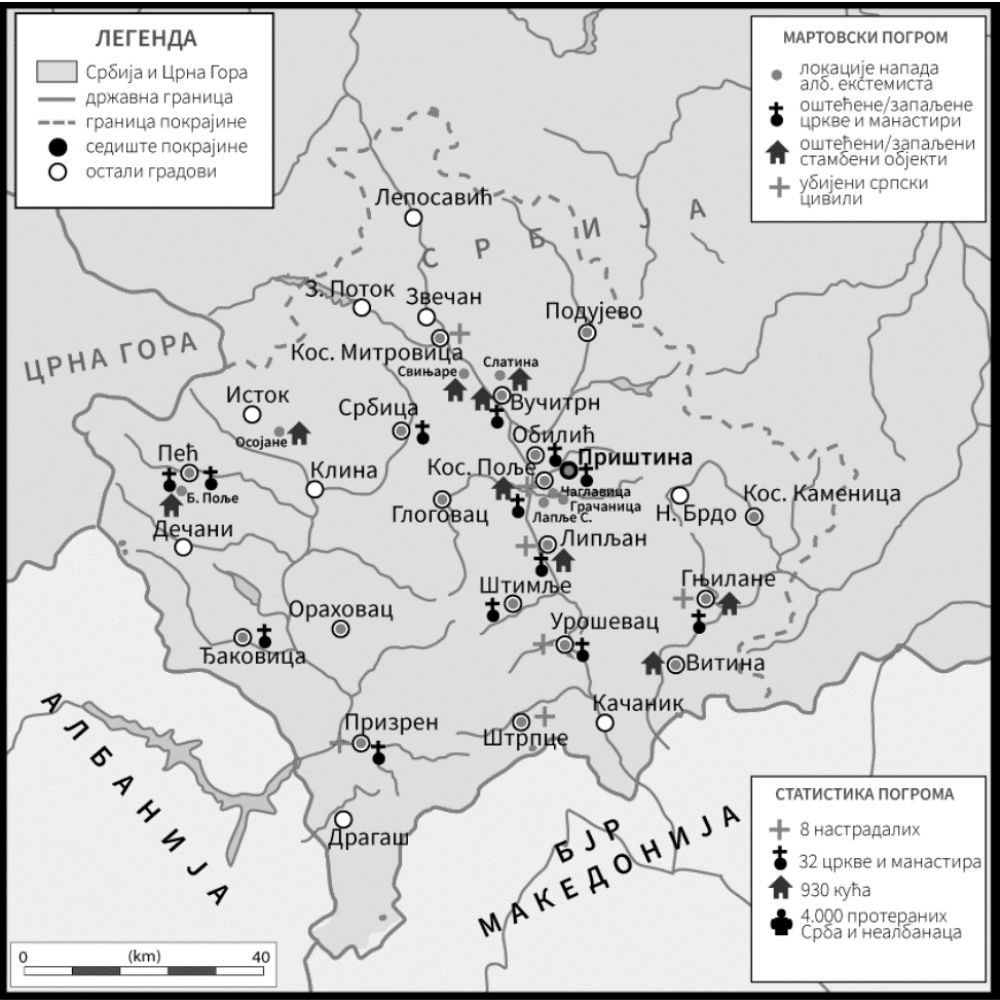
In the three-day riots, from March 17 to 19, Serbs were attacked not only in Kosovska Mitrovica but in a large number of places: Pristina, Čaglavica, Obilić, Kosovo Polje, Prizren, Lipljan, as well as in villages within these municipalities: Berivojce, Svinjare, Bresje, Miloševo, Kišnica, Slatina, Grabac, Biča, Belo Polje, and others.
The village of Svinjare was completely burned down (140 Serbian houses), and about 360 residents were expelled. In Prizren, in a suburb, during the night between March 17 and 18, the village of Potkaljaja was burned down; it was home to about a hundred Serbs who had not left the city in 1999.
In the mass attacks, riots, lynchings, and arson by Albanian extremists—which international forces attempted to prevent to a certain extent—a total of 24 people were killed, of whom at least ten were Serbs. 851 people were injured, 22 of them severely. Among the injured were 98 members of the UNMIK police and the "Kosovo Protection Corps," and 55 KFOR soldiers. Also, according to sources, 24 Albanians died as well.
The Serbian victims killed during the March pogrom were: Borivoje Spasojević and Jana Tučev in Kosovska Mitrovica; Nenad Vesić in Lipljan; father and son Dobri and Borko Stolić in the village of Drajkovce, Štrpce municipality; Slobodan Perić in Gnjilane; Zlatibor Trajković, Mirko Lopata, and Dušan Petković in Kosovo Polje; and Dragan Nedeljković in the Prizren municipality.
Tens of Serbs were injured or beaten. About 4,000 were expelled. Their property was looted and burned. A huge number of people participated in the three-day riots, approximately 51,000 across 33 individual clashes.
According to sources from the Serbian Orthodox Church, specifically the Eparchy of Raška and Prizren, a total of 100 houses—both inhabited and empty—and other properties owned by Serbs were destroyed. Villages where returnees had settled after the 1999 exodus also suffered. In the village of Belo Polje, all XX renovated returnee homes were burned down.
Destruction of Church Property and Cultural-Historical Heritage
In the extremist attacks during the March pogrom, 35 Orthodox churches and monasteries and dozens of cemeteries were demolished, burned, or damaged; bones were dug out of graves, desecrated, and scattered.
In addition to the Church of Saint Sava in the southern part of Kosovska Mitrovica, the Church of the Assumption of the Holy Virgin (16th–19th century) and its parish home in Đakovica were burned and razed to the ground, and in the same town, the belfries of the Church of the Holy Trinity, previously damaged back in 199X, were destroyed.
In Prizren, the Cathedral of Our Lady of Ljeviš from the 12th century, the Church of Christ the Savior from the 14th century, and the Cathedral of Saint Great Martyr George from the 19th century were burned down, along with the churches of Holy Sunday, Holy Healers, Saint Panteleimon, and Saint Nicholas.
The building of the "Kirilo i Metodije" Seminary and the Bishop's Palace were destroyed. Near Prizren, the Monastery of the Holy Archangels, the endowment of Tsar Dušan from the 14th century, was also destroyed. In Pristina, the Church of Saint Nicholas from the Middle Ages, renovated in 1830, was set on fire.
After KFOR evacuated the nuns, the 15th-century Devič Monastery near Srbica was looted and burned. Albanian terrorists also targeted the Visoki Dečani Monastery with mortar fire.
In these and dozens of other attacks on church properties, a large number of icons, frescoes, woodcarvings, and iconostases, as well as other objects of exceptional spiritual and cultural value, were destroyed and damaged. A catastrophic and major blow was dealt to the most valuable frescoes in Our Lady of Ljeviš. The same happened in other churches in Kosovska Mitrovica, Prizren, Štimlje, Vučitrn, and Uroševac, and the most important iconostasis in Pristina was completely destroyed. A significant part of the library fund, comprising books of various genres belonging to libraries of the Serbian community, was also destroyed.
Consequences
Examining the consequences, Serbian historian Milan Gulić stated that the March Pogrom represented the greatest suffering of the Serbian people in Kosovo and Metohija following the establishment of international administration, and that it significantly spurred further emigration of Serbs from the province. Furthermore, it managed to contribute to further Albanian homogenization, while UNMIK's measures even contributed to the Albanians' efforts toward unilateral persistence on independence. Under such circumstances, the second parliamentary elections in Kosovo under international administration were held on October 24, 2004.
The Pogrom in Memory
Serbian intellectual Živojin Rakočević wrote:
"The pogrom marked the lives of 120,000 Serbs, Gorani, Ashkali, and Roma with fear and turned into one of the fatal turning points of our history from which time is sometimes measured. It completed the process of ghettoization and deurbanization of Serbs. Fear became a way of life, and enduring and waiting for freedom became the only possible model of survival."
Speaking of the phenomenon of evil in a collection where he wrote the foreword about the March Pogrom, Rakočević also wrote, among other things:
"The phenomenon of evil in Kosovo and Metohija, no matter how forgotten it may seem, is a stain and a loss for the modern world. The bell that rings in Podujevo, near the crossing, in the fire of the pogrom, while a young man jumps and tears down the cross on the dome of the church, is also heard by those Albanians who today, due to a meaningless life and insecurity, flee to the West and leave behind empty houses, mostly in Podujevo."
Sources and Literature:
- Мартовски погром 2004: узроци, разарања, последице: тематски зборник од националног значаја. Предговор, Живојин Ракочевић, Архив Косова и Метохије; Дом културе „Грачаница“, 2025, стр. 5-16.
- Јован Ј. Алексић, „Дешавања у Косовској Митровици током 17.18. и 19. марта 2004. године“, у: Мартовски погром 2004: узроци, разарања, последице: тематски зборник од националног значаја, стр. 17-41.
- Ненад М. Антонијевић, „Мартовски погром: албански терор над српским становништвом на Косову и Метохији“, у: Мартовски погром 2004: узроци, разарања, последице: тематски зборник од националног значаја, стр. 43-82.
- Милан Гулић, Југословенска држава: 1918-2006, од Прводецембарског акта до Мајског референдума, Београд 2023, 911-912.