



In the second half of 1992, in the Middle Podrinje region, Muslim armed formations from Srebrenica began broad and intensive offensive operations directed at Serbian villages in this area. Continuous attacks, infrastructure destruction, and the mass suffering of the Serbian civilian population created extremely complex security conditions, forcing the Army of Republika Srpska to proceed with additional organization and the strengthening of defensive capacities. In this context, the Drina Corps of the Army of Republika Srpska, the last formed VRS corps, was officially established on November 1, 1992.
Attack on the Villages of Bjelovac, Sikirići, and Loznica
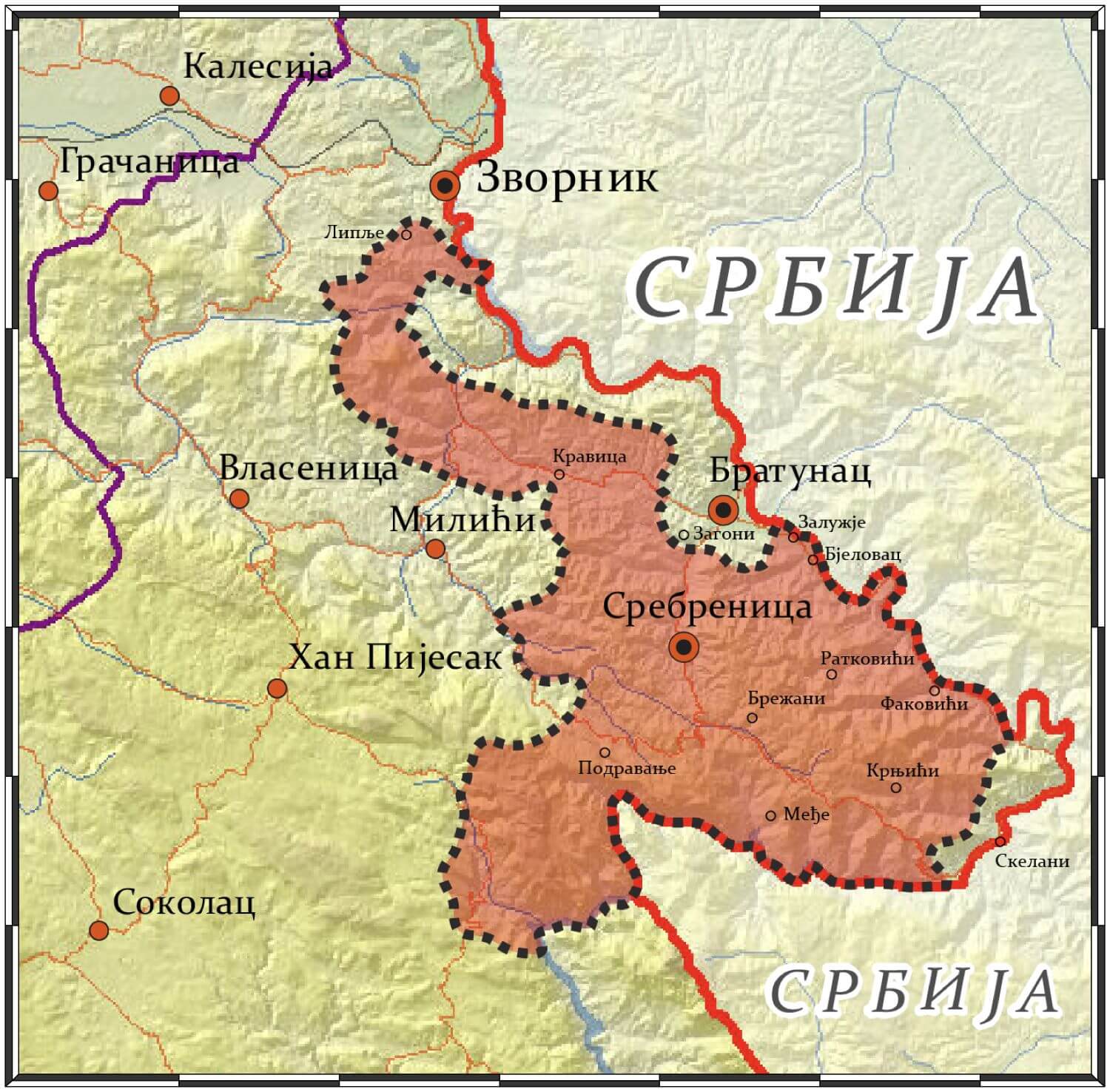
One of the major attacks in this area was carried out on December 14, 1992, when Muslim units from Srebrenica attacked the Serbian villages of Bjelovac, Sikirići, and Loznica in the Bratunac municipality. On that occasion, at least 58 persons of Serbian nationality were killed, while a significant number of civilians, mostly women and children, were taken into captivity.
The attack was accompanied by looting and the systematic destruction of the settlements, leading to the complete destruction of Serbian villages in this area.
Attack on Kravica
On Orthodox Christmas, January 7, 1993, Muslim units from Srebrenica carried out extensive attacks on Serbian villages in the Bratunac municipality, with a special focus on the village of Kravica and surrounding settlements. The villages were burned, looted, and destroyed, with a significant number of Muslim civilians from Srebrenica actively participating. The Serbian population was expelled, and 49 Serbian civilians and soldiers were killed. A number of Kravica residents were captured and taken to Srebrenica, where survivors were subjected to brutal psychophysical abuse, and some were killed.
The goal of these attacks was further advancement toward Bratunac and an attempt to cut the territory of Republika Srpska into two parts, as well as to inflict losses and spread fear and panic among the Serbian population.

Attack on Skelane
Following the capture of Kravica, Muslim armed formations from Srebrenica continued their attacks on January 16, 1993, in the direction of Skelane, where the Serbian civilian population was placed in a state of complete encirclement and forced to withdraw across the bridge over the Drina, which was under constant sniper fire.
On that occasion, at least 60 Serbian civilians and soldiers were killed. The youngest victims were five-year-old Aleksandar Dimitrijević and his twelve-year-old brother Radisav, who died while crossing the bridge to Bajina Bašta.
Consequences of the Muslim Offensive
These attacks rounded off the Srebrenica Muslim enclave, completely ethnically cleansed, which at that time covered about 900 square kilometers of territory across five municipalities. By that period, approximately 2,000 Serbian civilians and members of defensive formations had been killed in the wider Middle Podrinje area, after which the Army of Republika Srpska launched a counteroffensive and pushed the Muslim forces back to the narrow urban core of Srebrenica.
Kravica was liberated on March 16, 1993, when the first Serbian soldiers entered the burned and devastated village—devoid of a single living soul, with destroyed houses and clear traces of mass suffering.
Sources and Literature:
- Атласа злочина над Србима током Одбрамбено-отаџбинског рата, Том II, 1993, РЦИРЗ, Бања Лука 2023, 15-45, 71-105.